My veiws -Duty cuts ease imports, rare disease costs remain crushing nationwide
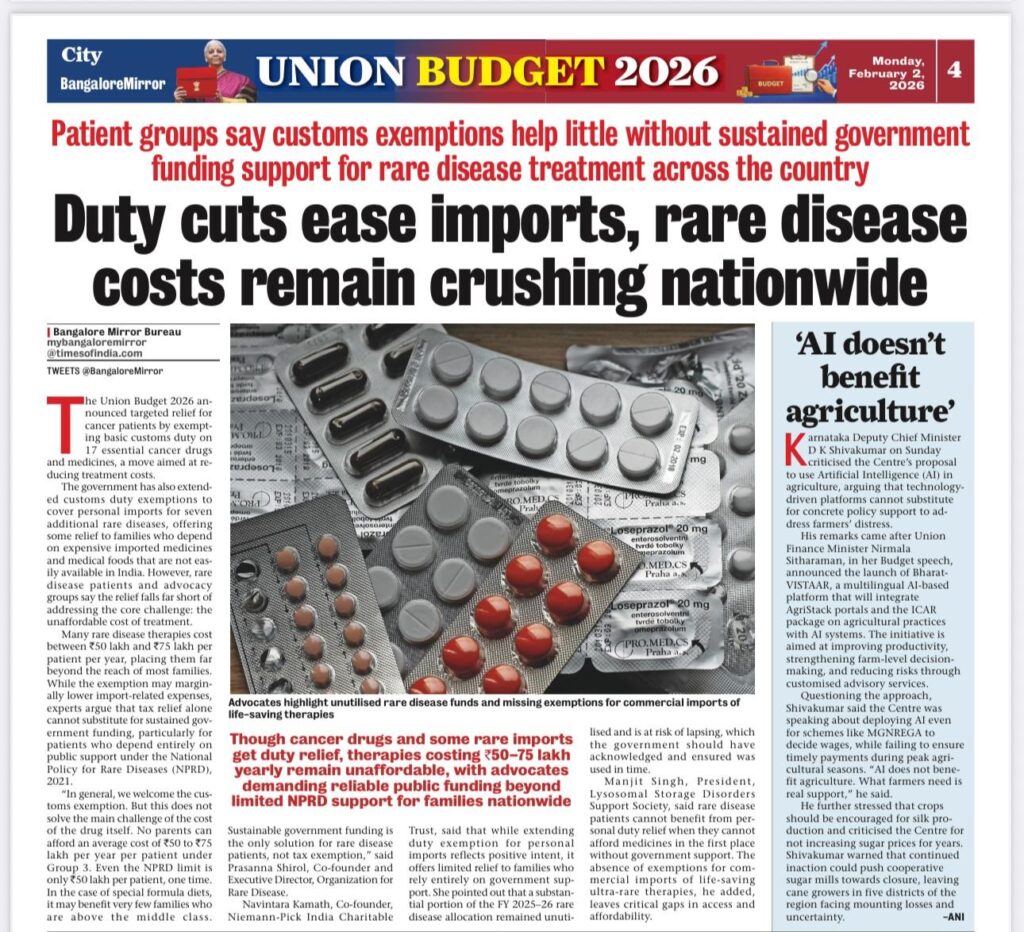
Duty cuts ease imports, rare disease costs remain crushing nationwide
Patient groups say customs exemptions help little without sustained government funding support for rare disease treatment across the country
The Union Budget 2026 announced targeted relief for cancer patients by exempting basic customs duty on 17 essential cancer drugs and medicines, a move aimed at reducing treatment costs.
The government has also extended customs duty exemptions to cover personal imports for seven additional rare diseases, offering some relief to families who depend on expensive imported medicines and medical foods that are not easily available in India. However, rare disease patients and advocacy groups say the relief falls far short of addressing the core challenge: the unaffordable cost of treatment.
Many rare disease therapies cost between ₹50 lakh and ₹75 lakh per patient per year, placing them far beyond the reach of most families. While the exemption may marginally lower import-related expenses, experts argue that tax relief alone cannot substitute for sustained government funding, particularly for patients who depend entirely on public support under the National Policy for Rare Diseases (NPRD), 2021.
“In general, we welcome the customs exemption. But this does not solve the main challenge of the cost of the drug itself. No parents can afford an average cost of ₹50 to ₹75 lakh per year per patient under Group 3. Even the NPRD limit is only ₹50 lakh per patient, one time. In the case of special formula diets, it may benefit very few families who are above the middle class. Sustainable government funding is the only solution for rare disease patients, not tax exemption,” said Prasanna Shirol, Co-founder and Executive Director, Organization for Rare Disease.
Navintara Kamath, Co-founder, Niemann-Pick India Charitable Trust, said that while extending duty exemption for personal imports reflects positive intent, it offers limited relief to families who rely entirely on government support. She pointed out that a substantial portion of the FY 2025–26 rare disease allocation remained unutilised and is at risk of lapsing, which the government should have acknowledged and ensured was used in time.
Manjit Singh, President, Lysosomal Storage Disorders Support Society, said rare disease patients cannot benefit from personal duty relief when they cannot afford medicines in the first place without government support. The absence of exemptions for commercial imports of life-saving ultra-rare therapies, he added, leaves critical gaps in access and affordability.
Source: https://epaper.indiatimes.com/article-share?article=02_02_2026_004_005_vkbgmr_Mirror